The other day I was given a sample of some lovely (if a little strange) oregano and rose soap. I was rather surprised to be told by the shop assistant that oregano could kill MRSA. It seems I missed this story towards the end of last year about a University of West England project that had received funding to further investigate the potential. The antimicrobial properties are apparently due to a compound called carvacrol. This looks like an interesting line of research, but what about my soap? How much cavracrol do you need to be effective, and how much of it is there in my soap?
I only have access to the abstracts on pubmed, but this study indicates a concentration of 200mg/l had an antimicrobial effect on E. Coli and this study found an antimicrobial effect with carvacrol levels of approximately 1.0%. Wikipedia tell me that carvacrol has a density of 0.9772 g/cm3, so that would make a 1% concentration in the order of 9800 mg/l, or almost 50 times more than the first study. I'm not sure of the details of the studies and how they would affect the concentrations of carvacrol required, but clearly they make a big difference. In lieu of further information, I'll go with the 1% figure for now.
The soap list oregano oil (origanum vulgare) as one of its ingredients, of which carvacrol makes up between 44 and 85% according to this paper. So, it would take roughly 2% of the soap being oregano oil to reach the 1% concentration. You can't tell from the list of ingredients just how much oregano oil is used, but 2% sounds reasonable to me*. I haven't taken into account dilution of the soap in water, but I have taken the conservative figures in the calculations, so I think that it shows that the soap is plausibly acting as an antimicrobial.
*This is definitely a weak spot in my analysis, I have no soap making experience on which to base this statement.
Showing posts with label science in everyday life. Show all posts
Showing posts with label science in everyday life. Show all posts
Monday, 29 June 2009


Monday, 28 July 2008
Total Eclipse!
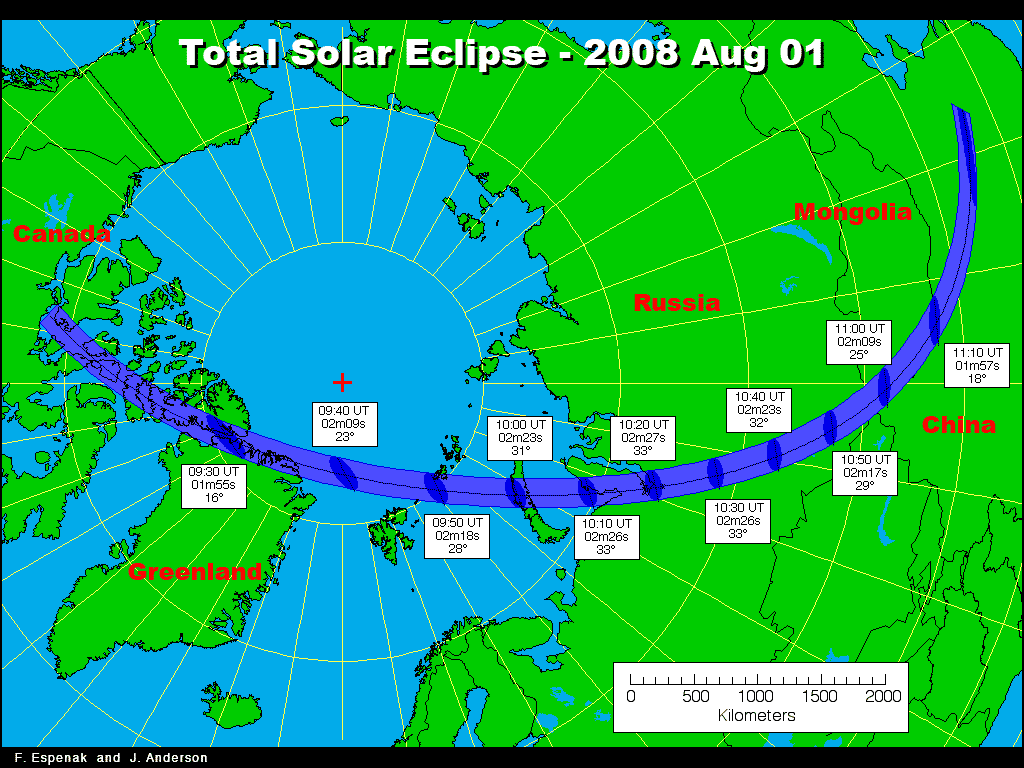
On Friday, 1st August 2008, there is going to be a total eclipse of the sun. Unfortunately, you will need to be in the arctic or northern china to see it, but most people in Europe should be able to see a partial eclipse. You can see an image of the path that the full eclipse will take here:
http://eclipse.gsfc.nasa.gov/SEmono/TSE2008/TSE2008iau/TSE2008-fig02.GIF
 This photo of the 1999 eclipse was by Luc Viatour.
http://commons.wikimedia.org/wiki/Image:Solar_eclips_1999_4.jpg
If you aren't in the right part of the world to see this one yourself, there are websites that will be showing the full eclipse. Scientific American has lots more details here:
http://www.sciam.com/report.cfm?id=solar-eclipse&sc=rss
If you are eclipse watching, remember not to look directly at the sun, especially through binoculars! For safe ways to view the eclipse, have a look here:
http://www.sciam.com/article.cfm?id=tips-for-eclipse-watchers
 This is a photo by NASA was taken from the Mir space station of the Aug. 11, 1999 eclipse.
 An eclipse of the sun happens when the path of the moon takes it directly between the earth and the sun. Essentially, the earth passes through the shadow of the moon. This is different to a lunar eclipse, when the moon passes through the shadow of the earth.
The shadow you can see is the area labelled the umbra in the diagram to the left. In this shadow is where you can see a total eclipse. Outside the umbra, in the penumbra, is where you will see a partial eclipse. If you have protective glasses, you should see a crescent shaped sun.
Happy watching!
http://eclipse.gsfc.nasa.gov/SEmono/TSE2008/TSE2008iau/TSE2008-fig02.GIF
 This photo of the 1999 eclipse was by Luc Viatour.
http://commons.wikimedia.org/wiki/Image:Solar_eclips_1999_4.jpg
If you aren't in the right part of the world to see this one yourself, there are websites that will be showing the full eclipse. Scientific American has lots more details here:
http://www.sciam.com/report.cfm?id=solar-eclipse&sc=rss
If you are eclipse watching, remember not to look directly at the sun, especially through binoculars! For safe ways to view the eclipse, have a look here:
http://www.sciam.com/article.cfm?id=tips-for-eclipse-watchers
 This is a photo by NASA was taken from the Mir space station of the Aug. 11, 1999 eclipse.
 An eclipse of the sun happens when the path of the moon takes it directly between the earth and the sun. Essentially, the earth passes through the shadow of the moon. This is different to a lunar eclipse, when the moon passes through the shadow of the earth.
The shadow you can see is the area labelled the umbra in the diagram to the left. In this shadow is where you can see a total eclipse. Outside the umbra, in the penumbra, is where you will see a partial eclipse. If you have protective glasses, you should see a crescent shaped sun.
Happy watching!
Friday, 11 July 2008
The Colour of Light
If you are like me, then you were probably taught in school that there are three primary colours: red, yellow and blue. So why do TVs and computer screens use red, green and blue? And why does the office printer use CYMK (cyan, yellow, magenta and key)? And isn't light a spectrum anyway?
To answer the last question first; yes, light is a spectrum. Light is part of the electro-magnetic spectrum like microwaves, radio waves and x-rays that all have different wave lengths. Visible light (to the human eye) has wave lengths between about 400 and 700 nanometres (one nanometre is 0.000 000 001 metres). The longer the wave length, the more red the light seems (shorter wave length look more blue).
The three colours concept is partly to do with our eyes. We see colour through 'cone cells' on our retinas. Humans have three types of cone cells that respond to three different wave lengths, and our brain combines the responses from all three types to determine the colours in between. We can use this knowledge of how the eye works to trick our brains into seeing the whole spectrum by using just three colours.
 For additive colours, like TVs, the three best colours for allowing us to see the whole spectrum are red green and blue. TVs are called additive colours because the produce the specific wave lengths that our eyes respond to, and by adding our response to each wave length together, we see the colour in the middle. For example, if we are seeing yellow on a TV, the TV is actually emitting red light and green light. This is picked up by our red and green cones, and our brain interprets the two signals by perceiving yellow (which is in between red and green on the spectrum). If the TV emits all three at once, then all the cones are reacting, and we perceive white.
 Printers, on the other hand, use subtractive colours: the pigments absorb light of different wave lengths to produce different colours. Normal daylight contains the whole spectrum of colours, and the pigments absorb specific bits of the spectrum. For example, if a pigment absorbed more blue light than any other wave length, then when we look at that pigment, the cones that respond to blue won't react, but the ones that respond to red and green will, and we will see yellow. If you then add in a pigment that absorbs red light (which by itself would look green-blue or cyan), then only the cones that respond to green will react. So if you mix a yellow pigment and a cyan pigment, you get green. Magenta is a pigment that absorbs green. If you mix all three pigments, all the light should be absorb, producing black. In reality, it is almost impossible to produce black through mixing three pigments like that, so K (just a black pigment) used by printers for better efficiency.
So what of red yellow and blue? According to the wikipedia page (http://en.wikipedia.org/wiki/RYB_color_model) , they where historically used from the 18th century. Although because bright greens are hard to produce with red, yellow and blue pigments, green was also often used as primary colour. Similarly, black and white were (are) also often used as primary colours too.
Tuesday, 24 June 2008
The Hole in the Ozone Layer
I was out in the sun with some of my friends the other day and the topic of the hole in the ozone layer came up (thanks to one of my Aussie friends). The hole in the ozone layer is more important to Australians than it is to people in the northern hemisphere, but the question is, why?
To explain why the hole in the ozone layer is mostly over the Antarctic (from where it somtimes spreads over Australia), I’ll start with a bit about ozone itself. Ozone is a molecule of three oxygen atoms. Mostly, oxygen atoms form pairs, which is what we breathe, but high up in the atmosphere short wave length radiation from the sun splits up these oxygen pairs leaving two free oxygen atoms. Oxygen atoms by themselves are not very stable, so they react with a nearby oxygen pair to form ozone.
One of the quirks of ozone is that it is very good at absorbing ultraviolet radiation (240-320nm). When ultraviolet rays are hit by an ultraviolet photon, they split up into a pair and a single atom again, absorbing the energy, and then the single atom reacts with a pair again to form a new ozone molecule, with the UV photon totally used up in the process. This is called the “ozone cycle”. When the free oxygen atoms end up together as a pair, then the cycle is broken. In the ozone layer, the recombining of single oxygen atoms into pairs is balanced by the splitting of pairs, and there is an abundance of ozone left to form the layer.
Things all begin to change when something else interrupts the ozone cycle. Some of the main culprits are chlorine and bromine atoms. For example, a chlorine atom reacts with an ozone molecule and produces ClO and an oxygen pair. The ClO then reacts with a free oxygen atom and you get another oxygen pair and the free chlorine atom back with no UV radiation absorbed by the process. And because the chlorine reactions happen faster than the ozone cycle, the whole balance has been shifted back towards oxygen pairs and there is much less ozone around to absorb the UV radiation.
So how does the chlorine get all the way up to the ozone layer? This is where CFCs (chlorofluorocarbons) come in to the picture. CFCs used to be used a lot in refrigerators, air conditioner and aerosol sprays in the 1980's, although they have now been banned. There are no natural sources of CFCs that we know about, so just about all the CFCs in the atmosphere are manmade. Further, because CFCs are generally stable and the chlorine isn’t used up in the process described above, it will take a long time before the hole goes away again.
Because the CFCs don’t react to anything in the lower atmosphere, they get caught up in the general air movement and get mixed throughout the whole lower atmosphere and are carried up to the stratosphere, where the ozone layer lives. Once there, the short wave radiation (the same radiation that breaks up the oxygen pairs) is the first thing the CFCs encounter that can break them up, releasing the chlorine atoms right in the ozone layer.
Finally I’m back to our original question; why is the hole over the Antarctic? Firstly, the cooling air in the winter and the rotation of the earth combine to form a large vortex over the South Pole. Because the vortex is so cold, clouds form (mostly from nitric acid; there’s very little water that high in the atmosphere – it all falls back to earth as rain much lower down). These clouds act as catalysts for the creation of the free chlorine atoms (i.e. they take part in the reaction, but are not used up by it, and in general make the reaction happen faster), so you have even more ozone destroying chlorine atoms then usual. This means you have much less ozone over Antarctica than elsewhere and this is what we call the hole.
There is also a small hole, sometime called a dimple, over the arctic. The vortex over the arctic isn’t as cold or as powerful as the one over the Antarctic due to the distribution of land masses. Correspondingly, there are less clouds formed and the whole (hole) problem isn’t as bad.
 Image courtesy of NASA (note this image is in the public domain)
This is obviously a complex phenomenon, so if you are after more detail on the ozone layer and its hole, here are some good websites:
http://www.faqs.org/faqs/ozone-depletion/
http://en.wikipedia.org/wiki/Ozone_depletion
http://www.theozonehole.com/
To explain why the hole in the ozone layer is mostly over the Antarctic (from where it somtimes spreads over Australia), I’ll start with a bit about ozone itself. Ozone is a molecule of three oxygen atoms. Mostly, oxygen atoms form pairs, which is what we breathe, but high up in the atmosphere short wave length radiation from the sun splits up these oxygen pairs leaving two free oxygen atoms. Oxygen atoms by themselves are not very stable, so they react with a nearby oxygen pair to form ozone.
One of the quirks of ozone is that it is very good at absorbing ultraviolet radiation (240-320nm). When ultraviolet rays are hit by an ultraviolet photon, they split up into a pair and a single atom again, absorbing the energy, and then the single atom reacts with a pair again to form a new ozone molecule, with the UV photon totally used up in the process. This is called the “ozone cycle”. When the free oxygen atoms end up together as a pair, then the cycle is broken. In the ozone layer, the recombining of single oxygen atoms into pairs is balanced by the splitting of pairs, and there is an abundance of ozone left to form the layer.
Things all begin to change when something else interrupts the ozone cycle. Some of the main culprits are chlorine and bromine atoms. For example, a chlorine atom reacts with an ozone molecule and produces ClO and an oxygen pair. The ClO then reacts with a free oxygen atom and you get another oxygen pair and the free chlorine atom back with no UV radiation absorbed by the process. And because the chlorine reactions happen faster than the ozone cycle, the whole balance has been shifted back towards oxygen pairs and there is much less ozone around to absorb the UV radiation.
So how does the chlorine get all the way up to the ozone layer? This is where CFCs (chlorofluorocarbons) come in to the picture. CFCs used to be used a lot in refrigerators, air conditioner and aerosol sprays in the 1980's, although they have now been banned. There are no natural sources of CFCs that we know about, so just about all the CFCs in the atmosphere are manmade. Further, because CFCs are generally stable and the chlorine isn’t used up in the process described above, it will take a long time before the hole goes away again.
Because the CFCs don’t react to anything in the lower atmosphere, they get caught up in the general air movement and get mixed throughout the whole lower atmosphere and are carried up to the stratosphere, where the ozone layer lives. Once there, the short wave radiation (the same radiation that breaks up the oxygen pairs) is the first thing the CFCs encounter that can break them up, releasing the chlorine atoms right in the ozone layer.
Finally I’m back to our original question; why is the hole over the Antarctic? Firstly, the cooling air in the winter and the rotation of the earth combine to form a large vortex over the South Pole. Because the vortex is so cold, clouds form (mostly from nitric acid; there’s very little water that high in the atmosphere – it all falls back to earth as rain much lower down). These clouds act as catalysts for the creation of the free chlorine atoms (i.e. they take part in the reaction, but are not used up by it, and in general make the reaction happen faster), so you have even more ozone destroying chlorine atoms then usual. This means you have much less ozone over Antarctica than elsewhere and this is what we call the hole.
There is also a small hole, sometime called a dimple, over the arctic. The vortex over the arctic isn’t as cold or as powerful as the one over the Antarctic due to the distribution of land masses. Correspondingly, there are less clouds formed and the whole (hole) problem isn’t as bad.
 Image courtesy of NASA (note this image is in the public domain)
This is obviously a complex phenomenon, so if you are after more detail on the ozone layer and its hole, here are some good websites:
http://www.faqs.org/faqs/ozone-depletion/
http://en.wikipedia.org/wiki/Ozone_depletion
http://www.theozonehole.com/
Tuesday, 17 June 2008
Why boiling water in the microwave is a bad idea!
Today at work the kettle broke. Being the caffeine addicts that we are, going without our coffee was simply not an option. My friend was surprised when I was tentative about boiling the water in the microwave, so she got an impromptu lesson in super heating and nucleation :-)
When you boil water in a saucepan, you may have noticed that you initially get small bubbles forming at seemingly random points around the pan. These bubbles are forming at small defects in the pan. These tiny defects hold microscopic bubbles that make it slightly easier for the new bubbles to form. This process of forming new bubbles is called nucleation and the small defects are called nucleation sites.
What happens if there are no nucleation sites? If you have a nice new clean mug/glass that you are using in the microwave, then this might well be the case. The short answer is that bubbles don't form. This means that the microwave is continuing to add energy to the water, heating it up, but the water isn't boiling. You end up with superheated water! The water is more than 100°C but still in liquid form in your mug.
Now you take your mug out of the microwave and add your coffee. The coffee granules create nucleation points and suddenly your water is boiling very rapidly!! The massive expansion of the water as it become steam causes the water to seemingly explode out of the mug and all over you (causing nasty scalds). This could even happen just by moving your mug of superheated water, so be careful!
If you are interested in a few numbers, there is a good article on this here:
http://www.phys.unsw.edu.au/~jw/superheating.html
They also have a video:
When you boil water in a saucepan, you may have noticed that you initially get small bubbles forming at seemingly random points around the pan. These bubbles are forming at small defects in the pan. These tiny defects hold microscopic bubbles that make it slightly easier for the new bubbles to form. This process of forming new bubbles is called nucleation and the small defects are called nucleation sites.
What happens if there are no nucleation sites? If you have a nice new clean mug/glass that you are using in the microwave, then this might well be the case. The short answer is that bubbles don't form. This means that the microwave is continuing to add energy to the water, heating it up, but the water isn't boiling. You end up with superheated water! The water is more than 100°C but still in liquid form in your mug.
Now you take your mug out of the microwave and add your coffee. The coffee granules create nucleation points and suddenly your water is boiling very rapidly!! The massive expansion of the water as it become steam causes the water to seemingly explode out of the mug and all over you (causing nasty scalds). This could even happen just by moving your mug of superheated water, so be careful!
If you are interested in a few numbers, there is a good article on this here:
http://www.phys.unsw.edu.au/~jw/superheating.html
They also have a video:
This is the mpeg format video taken straight from the above website (from the physics department at UNSW) - this video is theirs and all rights remain with them. They also have a quicktime format to be found at the above link. !
We did heat our water in the microwave and we didn't get hurt: our mugs are quite old and therefore have many hairline cracks and other such nucleation points and also we didn't quite heat the water to boiling (it only needed to be hot enough to dissolve the instant coffee).
I am please to report that by lunchtime we had a new kettle :-)
Subscribe to:
Posts (Atom)


 Posts
Posts